Interview by CD Boyland
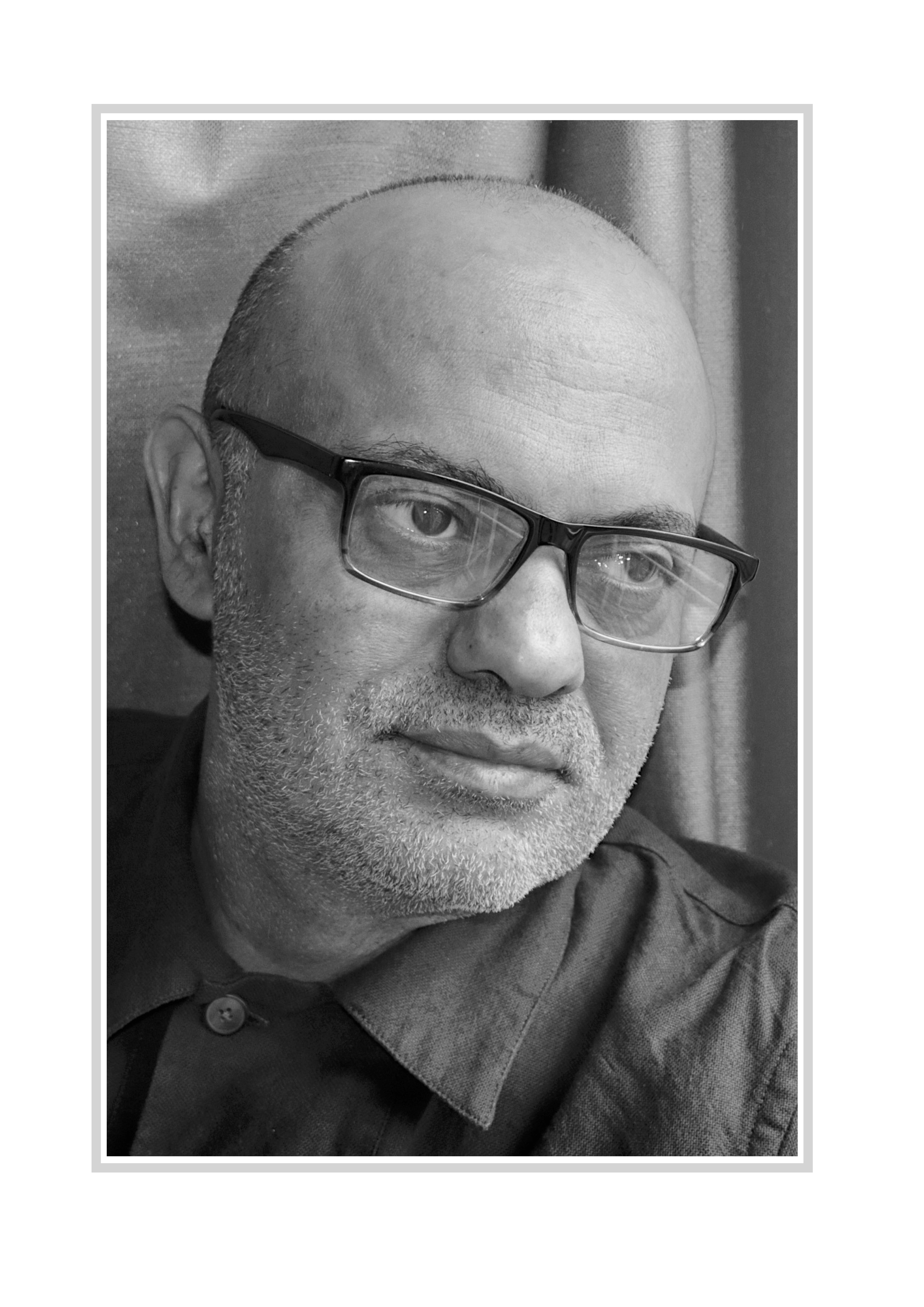
Born in Helensburgh, Gerry McGrath now lives in North Ayrshire. All the Pretty Lights is his third full-length collection of poetry and his first with Broken Sleep Books. It follows two pamphlets, published by Dreich and two earlier collections (Rooster and A to B) with Carcanet.
We’re grateful to Gerry for taking the time to answer some questions about his book and his writing practice and for permitting us to publish a short selection of poems from All the Pretty Lights, which you’ll find below.

Divided into eleven sections – the enigmatic titles of which (‘grey chicken legs of the box hedge’, for example or, ‘fat kings slumbering in wild garlic’) are taken from lines in the poems themselves – and featuring as many (mostly quite short) poems as there are weeks in the year, All the Pretty Lights is characterised by spiky dislocations of language-sense. Sliced or cut, as much as edited, reading these poems feels a little like running one’s fingers down a rough but tactile surface (sawn wood, for example) with the attendant risk that something sharp, a skelf, or protruding nail, will leave its mark.
As well as the recurrently arresting effect of specific lines (‘I wait for you in my human soup / of pea-skins & anarchy’, say or, ‘scales that fall / from the passing comet of a moth’) which sometimes stop the reader abruptly in their tracks, what emerges from reading (and re-reading) All the Pretty Lights is a sense that poems sharing common characteristics have been distributed between sections, creating vectors of communication, call-back and connection.
There are drolleries, there are elegies, spiky observations and interior interrogations which (when appreciated in toto), come together to form a kind of matrix – a collection of poems organised by as if by pattern (or the potential for pattern-making) rather than by theme or linear narrative.
Appreciating this allows the reader to linger on certain poems (the merry, ‘Chinese Whispers, A Down-To-The-Sea Scape’, for example, with its bouncing, Ian Dury’esque rhythms – or the wistful, grieving ‘Everyone Is’), understanding them as smart, electric executions of a type, as well as purposeful components of a finely-meshed and geared, complex whole.
In this way, All the Pretty Lights comes eventually to feel like the lives, and life it mirrors – complex, dizzying in the moment but evolving, going on as much behind the scenes as out onstage – and often best understood on reflection and with hindsight.
GRB: Hi Gerry, thanks for taking the time to answer these questions. Can I begin by asking you to tell us about a little bit about yourself, and also what inspires, informs and drives your poetry?
Gerry McGrath (GMcG): I was born and raised in Helensburgh, on the west coast of Scotland. After leaving school, I studied modern languages (Spanish & French) at Strathclyde University. There followed various other ventures, including studying Russian intensively for a year and teaching English in Spain. I became a school teacher in the early 1990s, but left in 2000 to recover from ME; the recovery continues. I’m married to Kate and we have two sons, Liam and Owen. We’ve lived in West Kilbride in North Ayrshire for eighteen years now.
Basically I’ve been writing poetry for around twenty-five years (reading it for a lot longer) and although the detail and circumstances might have changed, my approach has remained the same. The inspiration for my poetry is very often quite mundane; a minor detail here or there which I then advance and develop in the body of the text.
I do spend a lot of time writing and re-writing the poems, trying to find the correct notation, a matching language of precise, fresh imagery. Often that language begins with a specific sound, which is vague at first, then it clarifies. It sometimes feels as if I’m listening to a foreign language, or not even a language at all, a scratchy din of music. You wouldn’t believe how awful the first versions are, or maybe you would! I throw out lots of scribbles.
Then it begins to take shape, like slow lightning. I don’t mean a syllabic shape. I mean ‘listening in’, finding the right form to go with an exact syncopation. My poems are quite clearly informed by a long and close reading of the poetries of Europe, East and West, as well as further afield: Latin America, the Arabic world, ancient China. It’s where I took up residence, so to speak, in the very early 1980s and where I’ve been ever since. One or two things have come from the Anglophone tradition, but not very much. Mostly it’s been the cultures of continental Europe that I’ve gone to, I’m more comfortable there, more myself.
Above all, what I hope is that, after reading these poems, people come away feeling altered, as if the world (by which I mean the reality they perceive) has also changed. I’m never sure about using the word ‘should’ in a poetic context, but the experience of reading these poems should be a refreshing one, invigorating even, to borrow from Richard Price’s apt phrase. I was really impressed and pleased that he highlighted those expressions of tenderness and delicacy and beauty that act as scaffolding in the poems. It’s what I try to do: draw upon experiences we all share and make of them something vivid and new that stays in the heart and head a bit longer.
GRB: Could give us some insights into the background to this collection and how it came about?
GMcG: Yes, this is my third collection. I wasn’t expecting it to take so long, but I actually think it’s the better for having done so. The obvious difference between this book and the other two is the sense that a step change has occurred, both in the energy of the poetic line and in terms of an internal logic being rendered more explicit, more appreciable. There’s more flesh on the bones for one thing, more of a considered emphasis on poetic ‘shape’. There’s also more colour and vibrancy. There’s just ‘more’.
Why the change? What motivated it? About ten years ago, at a time of crisis and sadness, I went back to the book, having put it to one side for a while, and was struck that the new poems were of a different cast. I was intrigued by these new formations and alignments; pleased enough to go with it. The warmth of taking that “new path to the waterfall” is deeply felt in these poems. I sincerely hope people agree.
GRB: I was intrigued by the book’s structure – eleven sections, with four to six poems in each section. Can you tell us about your reasons for choosing to organise these poems in this way? In what way[s] was this necessary, in order to deliver the book you wanted? Also, how much moving around went on, between poems in sections, and the order of sections in the book? And, for a ‘Brucie Bonus’ – is there any significance to the overall number of poems (52)?
The first thing to say is that no, fifty-two is is not a magic number! In terms of the finished structure, my first instinct was to avoid overload. There’s lots going on in the collection, which creates its own stresses and intensities, and I was keen not to have it fall apart under its own weight. Each of the sections is a kind of mini collection of its own, fragments if you like, which then become part of a greater entity in the round. The poem I Ask is a good example of that; a ghazal in which poles of anonymity and reverence are ‘updated’: an attempt is made to maintain a balance between accord and discord.
I don’t want it to sound as if I always had a grand plan in mind, that this was all premeditated in some way. Far from it. This is Scotland, not post-war Poland, books need the chance to find their own legs, to be themselves. Whereas in the first two collections the poems are published in chronological order, here I shifted the furniture around. I knew that things had moved on the intervening years (since 2012) and wanted the collection to reflect poetic and personal evolutions. It was important to draw attention to that differentially, in engaging and challenging ways.
GRB: One of the most striking aspects of your poetry, for me, is your regular use of unexpected language/sense dislocations – lines (or phrases within lines) that feature sudden shifts or turns in meaning and imagery. (I’m thinking of lines like, “let me speak as a Russian nurse”, in ‘I’m Over Here’ – or “In the commentators coat hanger mouth”, in ‘up Law Hill.) Do you agree that poetry’s allowance for, and accommodation with these kind of vertiginous sense-shifts lies at the heart of its difference to prose? And, when you were creating these effects, were there ever times when you thought you might be testing the reader’s understanding too much?
GMcG: Good question and I respect the inference. I would point to another element, that of surprise. In many of these poems, disjunctions/pivots/switches are used to deliberate aesthetic effect. They are important, but they are essentially preludes to the main action, which is, invariably, an image or a phrase that indicates a crucial moment in the poem, a point at which something is either resolved or resists resolution.
I feel that an air of generosity surrounds these moments and that it’s effect is distributive: it travels back through the poem like an electric current, dispensing an energy that jolts even the most unassuming of lines so that a deeper layered sense of place and purpose is discovered. I didn’t get that from poetry in English because its conventions are other. It comes from somewhere else, from the experience of leaving and coming back. These poems are my attempt to make that experience manifest.
GRB: In a similar vein, I feel a lot of the impact of these poems comes from their abruptness and ‘honed-ness’ – the sense of language very finely pared down to stunning effect. Can you tell us about your editing process – do you edit a lot or a little? Do individual poems stay very separate throughout, or do you practice cutting-up or cutting-together, to generate those arresting image/language splices?
GMcG: Yes, I edit a lot. Normally a poem involves endless re-writes. There is always more than one process going on at the one time. What I mean is, sometimes you spend ages on something, edging towards a conclusion and suddenly there is clarity and the poem is actually a different beast entirely. It can feel as if it’s just falling out of you. Some good stuff has to go, of course, but I don’t worry, if it’s so good it’ll come back.
I try to work hard at bringing out a sense of freshness to my writing, particularly so far as the images are concerned. Occasionally an unexpected direction comes from re-arrangement, literally taking something and letting it find its space elsewhere on the page. That sounds simple, but it can be a revelation. And then there are times a poem doesn’t want to be resolved and you have to break the line in order to find its real centre of gravity. Poetry is not always about poise, but it is always about tension.

GRB: As I read through All the Pretty Lights, I noticed the balance you strike between accounts of the interior mind (the thoughts/feelings of the poetic ‘I’) and observations of the exterior world – is it necessary to you, to maintain this balance between the interior/exterior, or do you find that you (and your poetry) prefer to spend more time in one than the other? (If so, which?)
GMcG: Another great question. My poems aren’t really about ‘states of mind’ or catharsis or anything like that. I mean in the same way that they are not really ‘Nature’ poems. They are more like little events or actions that build layer upon layer, working towards a climax or conclusion that occasionally happens. As has been pointed out already, the poems exist on a knife’s edge, they walk a high line between two separate but very compelling worlds. So very Scottish in that regard, as well as European.
GRB: You stay in Ayrshire these days, and there are a couple of specific Ayrshire place references that feature in All the Pretty Lights – Portencross and the Electric Brae near Culzean – how important are place, locality and the connection[s] you feel to your local landscapes to you as a poet?
GMcG: Yes, those are places that will be very familiar to some people, with the possible exception of Portencross. They recently re-opened the roof of the twelfth-century castle there that you can visit and cast your eye up and down the river. I think it’s important that readers are given the space to decide on their own response to poetry.
Suffice to say the poems in this collection are very dramatic; they have a bright, purposeful theatricality. They are also sonic narratives, stories in sound that play out sometimes in major, sometimes in minor keys. The great Spanish poet, Miguel Hernandez, who died of tuberculosis in a mediaeval dungeon in 1940, wrote, “I am a prison whose window / opens to huge roaring solitudes”. Hernandez was tapping into something very old, into other spaces that are actually much closer to home.
GRB: There’s a bright vein of humour and wit running through All the Pretty Lights (the ending of ‘Fond & Ancient History’, for example – “if we accept mystery / as the moment when” – made me laugh out loud). How important is humour to you, as a poet? And how did you go about balancing these moments of laughter and levity, in terms of your overall structure and vision for this book?
GMcG: Yes! Thanks for pointing this out. Humour is a big part of the poems’ personality. The more serious they get, the funnier they become. Poems like Birds and Waves are stamped with it. This is the West of Scotland, everything passes through the prism of humour. Without it there’s no tension, which means no buoyancy. And what would we do then? Swim with the fishes probably.
GRB: There are a lot of birds in these poems – I may have missed one or two, but I noted goldfinches, pigeons, a robin, rooks, oyster catchers and a pee-wit. There’s also a reference to ‘bird economies’, and people being both ‘disarmed’ and ‘denied’ by birdsong. What do birds mean to you, in terms of their operation as symbols in, or functional components of poetry? Once you’ve included a bird (or birds) in a poem, does it limit the scope of the piece (e.g. by making it, for better or worse, a ‘nature poem’) or is there a universality to ‘bird-being’, that makes them useable in any context?
GMcG: I hadn’t really focussed on this at all. I think it might really go back to what I was saying earlier about ‘shape’ and writing a poetry of ‘events’. I spend a lot of time just observing, looking at things and wondering what they remind me of. The use of birds in the poems is not systematised. They are a licensed image, a way of allowing poetry to show how easily and comfortably and confidently it moves in trying conditions.
GRB: Along with the birds, there are three appearances by dragons, two of which feature in successive poems, on opposing pages (In ‘Electric Brae’ – “the last of the dragons is gone” and ‘Found Picture’ – “Men & women who dipped their pens in the great dragons of light”). Both poems infer absence and loss – is there a connection here between the mythopoetic dragon and the experience of loss, of something slipping away into an unrecoverable past, that might as well be myth because it will never be real again?
GMcG: Ah, yes, the dragons! In the poems you mention they have specific roles that are concerned with introducing a note of sentimentality as well as a kind of archness. I’m having a wee bit of a laugh at my own expense, too. Sometimes you can’t quite believe where a poem wants to take you and if you decide to go with it, you have to do so wholeheartedly.
I think the dragon images work as something of a two-way valve in both of those poems. They help to elevate things, plus they have a certain self-possession, like those high-wire acts you see between skyscrapers or across a falls where someone stops halfway across and sit down to enjoy the view.
GRB: All the Pretty Lights also features a number of ‘special guest appearances’ – by poet and artist, Mina Loy, the Scottish Colourist painter Francis Caddell and the Greek poet Constantine Cavafy. How did this small but distinguished group of artists and writers come to appear in your poems? What singled them out to you?
GMcG: The poem about Mina Loy followed on from a review I’d been asked to write of an excellent book about her by Tara Prescott. It was about the time I was reading John Berger’s wonderfully sane book of selected essays on art and artistry and the two things came together.
We have a print of a beach painting (“Iona, East Bay) by Francis Cadell that hangs on the wall in our living room. Cadell was expert at making the unassuming appear radiant. There’s a strip of beach – hiding almost – at the back of the painting, I must have looked at it a hundred times.
Cavafy has always been something of a favourite. There are no glosses in his poetry, just realities and counter realities. It’s the importance he attaches to playfulness. His writing is a constant reminder that you have to leave home to be a poet. He is also heartbreaking.

GRB: What are you reading right now, and would you like to recommend a couple of your current favourite books to our readers (these can be poetry, prose or anything else you’re enjoying)?
GMcG: I’ve just recently been reading Kiss The Eyes of Peace, Brian Henry’s translations of the Slovenian poet, Tomaz Salamun. It’s truly fantastic. Salamun was a name I’d heard but never really read. The poems are remarkable; the real thing and genuinely funny. Actually they remind me of Cavafy in that they manage poetic precision without falling into bathos or luxuriant ontology. The image-making is superb. Just when you think he can’t possibly do better, he does. I see him in the way I do Cavalli or De Coninck. If you want to know what’s been going on in continental poetry for the last fifty years, buy their books – and digest slowly!
I’ve also been re-reading Bernard Malamud’s novel The Fixer. I read it about thirty-five years ago and struggled. I was the problem, not the book. The writing is wonderful – precise, sane, reflective and probing. I’m glad I found it again, given its themes and what’s been going on recently.
GRB: Finally, what writing or other projects are you working on, at the moment?
GMcG: I’ve been working on a new book for a wee while now. I’m several poems in and quite happy thus far. It hasn’t begun to take shape yet as a collection, but it will. It’s similar to All the Pretty Lights, but with certain key developments. I just hope it doesn’t take another twelve years!
All the Pretty Lights is available now from Broken Sleep Books.
Belvedere
So they were sitting beside the belvedere, in shade.
And they were drinking, barely exchanging a word.
The sun was shining and words were beyond them.
Past the low stone wall lay the river. Further off,
lost in the thin blue air, were the island’s three peaks
yet to exist, as if they existed.
A breeze got up; the world tilted and water, seen
slopping up the side of a glass, pushed the air ahead,
carrying birds, the clink of ice, notes of lemon.
On the lawn children ran like small dogs, yelping
with a mix of terror and joy, and occasionally
a mother or father appeared to gather them in.
He thought there must have been days
when people forgot even that they had gone to sleep
and woken, re-born.
That they had flowed, like the river behind
the wall flowed, huge and still and countless,
grey as all rivers are grey.
The sun continued to shine and the breeze blew fresher
and he drank again and thought
in the eyes of small dogs days like this will come again.
Goyesca
after Mina Loy
1.
Flung to the moon
Straw Pelele
Watches the night
Shadows bloom
shrink
Majas in their livery
Under drawn
Behold
The bird-economies
Plumed in syllables
The lunar dust
Of Goya’s jig
Rise from a body
In trampoline rags
outsize wig
2.
Life-substitute
‘Tween dance
& word
He peaks
In the higher air
Face haunted by the sun
A kinder science rolls
Across that lenient tongue
Blasé, glassy-eyed
To the marbled prospects
That once were he
Paree
to the cooked meats
of Bowery
Preferring languor
Sky-worn bliss
To the idling coma
Of a sculpted wrist
3.
Gravity brings him
down
Unmarked from jinks
With the cracked
larks
To the calf-skin bed
Of the tauromachs
Feeling atoms of disgust
The time-served majas
weep
Rouge their cheeks
Draw the blanket
let him sleep
The Makings of a Good Conversation
If the dead could speak, who wouldn’t
give himself to honeyed afternoons
in their company, to the cool judgement
of the mind meeting the everyday?
The male sits in a languid seat.
In the street opposite a tree unknots
a crooked branch to a nib, sketches
a pianist’s long-fingered promenade,
the mineral indecency of light.
It’s a lie the seasons click their heels.
In the rearview, a tick-tock heart
clocks the captain’s perfumed daughters
finalising their hair in the honest glass
of urban children. They wonder, sometimes
aloud, sometimes not, how long
in the surrendering heat of an August evening
their dark fruit can endure.
Poems from All the Pretty Lights by Gerry McGrath.
Our thanks to Gerry for permitting us to share his work


Leave a Reply